Session Recap: Branching Reimagined: Key Takeaways from Gina Bleedorn
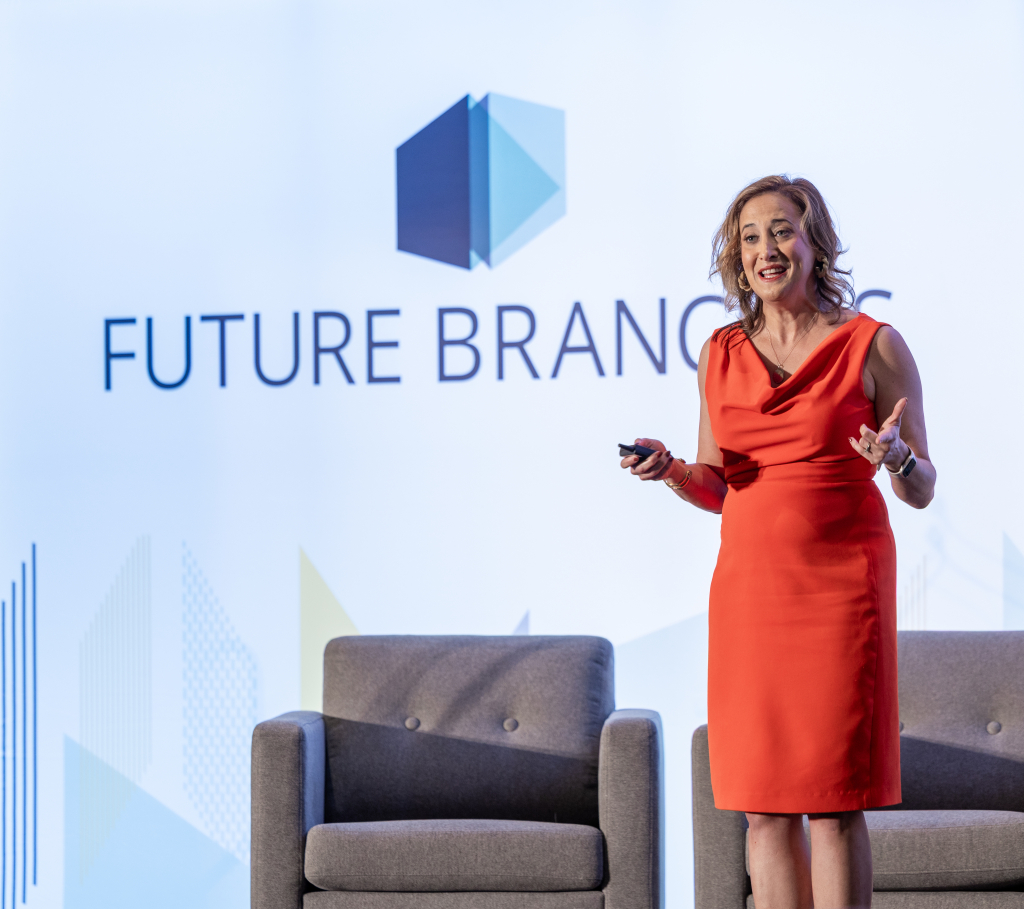
In the keynote session, Branching Reimagined: Merging Data and Design for Strategic Transformation at Future Branches Boston 2025, Gina Bleedorn, President & CEO of Adrenaline, unpacked the resurgence of bank branches. Introduced by EJ Kritz of DBSI, Bleedorn combined macro trends with client experiences to guide banking leaders on winning the "great branch race." This session matters for industry executives navigating network optimization, as branches drive acquisition, advice, and loyalty in an omnichannel world.
Key Takeaways
1. Branches Are Thriving Despite Digital Hype
Bleedorn debunked the "bank branch is dead" myth, citing 2023 data showing net new branches added for the first time in a decade. Major players like Chase (500 new locations), PNC (200 branches, $1.5B investment), and Wells Fargo are expanding, as 86% of consumers used branches last year and over half of account originations happened in-person. Branches excel in relationship quality, yielding 7.2x higher balances after one month versus digital.[1][3]
2. Close the Analytics-Strategy Gap for Better Decisions
A key disconnect occurs when data insights fail to inform "what to put where" and "what to spend where." For Incredible Bank, analytics pinpointed Fort Myers for expansion, leading to a non-traditional drive-thru flagship with ITMs and concierge service. New York Community Bank/Flagstar's 450-branch conversion used tiered budgets and scalable kits for consistency, proving targeted spending boosts profitability amid 56% de novo failure rates.[1][3]
3. Make Design Fit for Purpose with Multiple Models
Branches now prioritize being a "front door" for acquisition, financial advice, human service, and efficiency over transactions. Bleedorn advocated archetypes like wealth-focused or LMI formats, as seen in Origin Bank's community renovation in Louisiana versus a Dallas flagship. Achieving critical mass (6% market presence) doubles market share outperformance, but nationals lead due to brand halo.[1][3]
4. Bridge Design-Execution for Scalable Impact
Execution at scale demands speed and localization, as in LGFCU's 12 branches in 11 months post-spinoff. Low-cost refreshes ($2K-$1M) for Meijer Star CU and PNC wealth sites show "doing more with less." Valley Bank's Fifth Avenue flagship uses Pixel Flex tech for billboarding, emphasizing flexibility and perceived convenience.[1][3]
Even consumers who prefer online also want the security and reassurance provided by nearby branch. Even if they never use it, the safety of knowing it's there.
— Revel reveal study (quoted by Gina Bleedorn, President & CEO, Adrenaline)
Why It Matters
Bleedorn's insights address siloed functions—analytics, strategy, design, execution—that hinder transformation, especially as regionals lag nationals in de novo profitability. With branches shifting to advice and acquisition amid digital transactions, banks face a race to reinvent networks. Her client stories from PNC to credit unions highlight opportunities in multi-format strategies, helping leaders prioritize quality over quantity for sustainable growth and customer loyalty in competitive markets.[1][3]
Actionable Insights
- Use analytics for site selection: Plot customers, growth, and sub-markets to guide expansions like Incredible Bank's Fort Myers flagship.
- Tier budgets by opportunity: Scale designs with kits of parts, as in Flagstar's 450-branch conversion.
- Develop branch archetypes: Match formats to purposes like acquisition or advice for network transformation.
- Prioritize execution speed: Enable flexibility and localization to launch at scale, reducing costs while maximizing impact.
Want more insights from Future Branches Boston 2025? Explore the full agenda.
Click to View Full Session Transcript ▼
[2025], [Future Branches Boston]. [Keynote] – [Day 1, Track A - Branching Reimagined: Merging Data and Design for Strategic Transformation]
EJ Kritz, Chief Experience Officer, DBSI: All right. We wanna keep the party rolling
yo, because I'm just saying I know the next speaker pretty well. Are you ready to keep the party rolling, Gina? I'm trying girl. Hey, we're in a branch transformation world and one of the things that's really special about our space is the number of companies like DBSI and like adrenaline that are all doing pretty incredible stuff.
And it is a unique honor to get to introduce one of my peers in industry. The CEO and President of Adrenaline, please welcome Gina Bleed.
We have double clickers.
Gina Bleedorn, President & CEO, Adrenaline: EJ don't you Click well. I'm doing my thing. Okay, we both have clickers. Good morning, hap happy to. Keep the party rolling. So every time I am on this stage, I feel compelled to bring together the trends we're seeing in the industry. With what we're experiencing with clients on a day-to-day basis with our ears to the ground and bring that forward into hopefully what you should do about it.
And so I hope this is helpful. I'm going to start with the macro trends that are happening. Beginning with the bank branch is dead. I am just kidding. It's not dead at all. That was what a lot of people were saying, including the mainstream media in 20 18, 20 19, leading into the pandemic. And then you can see a lot more headlines around the death of the branch, the retail apocalypse closing bank branches, and then of course, post COVID.
We did close a lot of. Bank branches because there was a great industry right sizing, but many of you know this. In 2023, we added more net new branches for the first time in a decade, and then beginning in 2023, heading into 2024. We started seeing headlines like this. Certainly Jamie and Chase out in front opening 500 new locations, renovating 1700 B of a renovating entire network, more than 165 PNC.
They said in the spring of last year, they were gonna invest a billion and build a hundred new branches, and then by. Fall. They said, just kidding. Make that 1.5, 200 new branches. And PNC is our client. We are their retail partner helping them on this journey. And I'll tell you, it's not easy to do scale this big.
And when we look across the industry, it's. It's not just the big guys, although you see a lot of big guy headlines here. And there's many other smaller guys that are doing exactly this same thing that aren't making the mainstream and industry media headlines, including one of the latest, just this month, Wells Fargo's out of the penalty box and they are leaning into branches again.
How about that? The reason everyone is investing in branches is in case you didn't know because they work. So this is the latest stats about industry trends around branches. So you see, you've seen many versions of this, and researchers and all kinds of consultancies keep doing research and keep finding similar stats.
Seven of 10 prefer a branch within 15 minutes. And actually. That's a great rule of thumb right now. It's what a lot of the big guys are doing, being within 15 minutes because people can drive a little further. Now, you also see, and this is really surprising, 86% of people have used a branch. In the last year, and actually the head of retail at Wells said, we are seeing transactions go down, but people coming in to meet with bankers going up, and so that's accounting for that.
And then while of course digitization continues and regular transactions continue in digital channels, things like account origination and scheduling to meet with a banker and resolving issues. Still have very high branch propensity, and then when you see what actually happened last year, over half of account originations were in person.
I'd Really, the psychological underpinning is by one of these studies, a Revel reveal study, this quote, which I really like. Even consumers who prefer online also want the security and reassurance provided by near, nearby branch. Even if they never use it, the safety of knowing it's there. And then if we look at how it's actually performing, you can see very divergent statistics here on what digital originations versus in branch originations look like.
The point is branch banking yields generally more quality results in relationship. So you see 7.2 times after one month. The branch quality of relationships from a balance standpoint, and then after six months, still two and a half times. And then if you look at the relationship retention, clear trends that digital customers tend to be fleeting.
So at the end of the day, we should listen to what Jamie and his very big face say here, that people like to visit their money, but the nature of the branches change. And that's really what we need to accommodate for. And what I am seeing in the industry is that change at this scale and this level is hard.
And thus we're in a race. Really the great branch race, as I call it, but not everyone is running the right race, and not everyone is running it for the right reasons. It's not just about how fast you get there and proof of this is this slightly disturbing stat. That 56% of denovos fail to reach profitability.
And so this is a Kiran OS study. Kiran OS is our strategic data partner focused on the industry. They have the best they, they are the best data provider in our industry by far. What you see here. Is a big disparity between nationals, which tend to have the all boats rise, presence factor, awareness factor.
So they're doing the best, but regionals and super regionals in this study were lagging behind quite a bit. And then what you also see on the chart on the bottom right there, a lot of hit and miss variability. This is from the same bank and you're seeing just some work, some don't, and by the way, in the red there, just a good rule of thumb, think about targeting about a million in branch spend for every 10 million in deposits.
And you wanna reach for most of you, in most markets, 30 million by year three. But something else to be aware of. If you don't reach your profitability mark by year three, statistically chances are very low, you're ever gonna hit it. And so thus, how do we make sure we have more hits and less misses? And I wanna point out.
A problem. We are having a great disconnection that is disabling transformation, and it is really because of the dynamics you see here. You have all these different functions. You may have some of them, all of them in your banker credit union. They are often quite siloed and everyone is doing the right thing, but not necessarily together.
And these disconnects are ultimately burying in some cases, strategy and blurring accountability, and then. You actually never get the traction that you need. And in addition to these main functions that apply to the branch network, you have these other things like digital and sales and IT and brand and compliance.
And so if everyone is not moving together in a symbiotic way, change will never happen. Much less getting to a new state of BIU. So if we look at then what the chain of disconnect really is, I'm going to. Focus really the rest of what I have to say on closing these gaps, because bad things are happening in the gaps, in the gap between analytics and strategy.
You have a problem where insights are often gathered, but they are not meaningfully activated. So for instance, I know, ooh, the data says I should be in this market, in this area of the market, but. Is the data informing how you should show up? What is your method or model of retail delivery? So what to put where, and then what to spend.
Where are two of the biggest gaps around decisioning that aren't happening as they should between analytics and strategy? And then gap two between strategy and design. And actually really all of strategy is a big gap because so many do not have a concern. Deserted retail delivery strategy, and that's because you need to reinvent in a very changing landscape.
Just a few years ago, we weren't sure if branches were gonna make it, and now we need to reinvent how they're done. And everyone's trying to do it as. Fast as possible, and it is difficult to do change and figure out change at the same time. And so then what you've got is you might actually, if you have a strategy on how you wanna show up, maybe a high level vision, it's not actually being brought all the way down into the design of the space.
And most informatively not having multiple models because if you have a one size fits all, that cannot yield success today. You have to have varying sizes and varying formats. And then finally, there is yet another gap between design and execution. And what ends up happening here is even if you design a perfect new North Star branch of the future or whatever, the rolling out of it.
Proves to be a problem, and especially when you're trying to go fast at scale, be consistent, but also localized, that becomes a real problem. And so enabling change at scale is a difficult thing, and I hope I'm going to give you some tidbits about how to close each of these gaps. And really it sums up into making better decisions between analytics and strategy, having design fit for purpose between strategy and design, and then actually making impact between design and execution.
And Andrew talked about doing more with less. That is really the name of the game. How do we be as big and impactful as possible? Spending as little as possible on as little real estate as possible. And that is not an easy thing. So in Gap one I mentioned Better Decisions. Two things, what to put, where and what to spend where.
And I'm gonna start with an example. This is about a $2 billion bank called Incredible Bank. Luckily they have incredible service because. If your name is that you, you need to, and great bank focused in Wisconsin, that's where they were based, but a large contingency of snowbirds down south. And so they decide we're gonna open a new office in Fort Myers, one of the fastest growing markets in the country.
So the way we look at that when we do analytics, and hopefully you have at least some analytics if you do them, think about doing them this way. So we plotted at the time all of the customers, so we know where they are. We looked at favorable concentrations where you've got the right amount of market growth, and then we plot out what we call.
Sub-markets that are identifying areas of opportunity, we rank them and we figure out what is the fair share gains you can have there, and that then yields a real estate search. This is a best practice approach to using analytics, particularly in new market expansion, to figure out where you wanna go now.
They have no awareness besides their customers that are down there. They have no market awareness for acquisition. Nobody knows an incredible bank, and they wanted, particularly the CEO said to us and even to me specifically, make my branch look not like a bank. Or I will fire you. So he wanted a very avant-garde looking different experience.
And this is what we did. And actually it was inspired by that Taco Bell drive-through. We saw earlier this is actually a branch that celebrates the drive-through. And it did so because all of the insights revealed that drive up banking is the preferred method of banking. But at the same time. People want human service.
So this was designed to be basically a giant billboard and you see it doesn't look anything like a bank that allows for servicing through the drive up. And I've also got an ITM on here because we had designed some ITMs for incredible bank in their Wisconsin market. They were super, super effective.
They loved them. And the CEO actually wanted to start by just putting some ITMs down south and we said. No, you cannot enter a market with ITMs only. You have to enter with a flagship. So that's another good rule of thumb. ITMs are there as dot connectors and they're there as supportive hubs. But also, this is how this branch works and your word of the day is port share.
That is an architectural term that refers to what this is, but basically it's a giant canopy, and so you can see there's actually two lanes here for ITM drive up traffic, and then there is a drive up. Park and get concierge, curbside service model. And so this was designed so that there's full visibility to the drive up, so the bankers come right out when they see them.
And then there's full ingress egress to get all the way around. Great model, super successful. A tangible example of experience in action. And they're building more of these because they're working so well. That's one example of how to go, where do I go and how do I figure out and use analytics to inform what I put there.
But then let's go to a very different example about what to spend where. So this is New York Community Bank and Flagstar merged together to create a new Flagstar. We did all the conversion work for them from the design through the implementation. This was 450 branches. This was no easy task to make look consistent, but a key to making it work was having smart strategies for allocating budget and having tiers so that we had a corporate tier.
And then we had three tiers based on opportunity that you see here. And the majority actually of the budget spend and the locations were in tier two. The tiers. You don't necessarily know you're at a tier three when you're at a tier three. But key to making this work was designing the kit of parts to be scalable, to be flexible, and to be able to flex up and down.
And then having a decision tree that informs what to do where. And so when you see the end examples, you see just beautiful consistency and. I am biased, but I do believe this Flagstar example of branch conversion and refresh with an m and a is the best in the industry that you will see. Any Flagstar 450 locations you go to across the country will look consistent, and it is not easy to do that when some of your branches start looking like that and you have to-read everything.
But it turned into a successful program. And something else to mention too, the importance of marketing. And you see a digital screen circled there. And also localization. Every branch not only had a welcome to whatever branch name sign, but also a list of other branches in the region. And so it's supporting the idea of perceived convenience and localization.
A great example of what to spend where and how to allocate cost. We will go to gap two between strategy and design. And this is making what you are designing fit for purpose. And let me be clear. I love beautiful buildings. I love beautiful things, but form must follow function. Function has to lead the day and you have to have multiple sizes.
So when we. The purpose of branches. This is the new purpose of branches for consumers, period. And it is a 180 degree flip from what it used to be. The number one purpose is it's the front door. It is a beacon. It is the reason when Andrew said this as well, they choose you because they drive by and. See you.
If you are not in market, you are not in consideration. Second to that is financial advice, and this is also the risk because if you are not prepared to service financial advice in the way consumers want, they will go elsewhere and you will lose that opportunity. The. Is actual human service. So this is largely problem resolution and it is mitigating attrition.
And then the fourth thing, what most bank branches still today in this country were built for servicing transactions. That is the least important thing for go forward. So think about that and then think about how the purpose for consumers should. Turn into how you derive value so that front door for them is acquisition for you, and you see some examples of that, of billboarding, of inside out of day night visibility.
These are all different projects we've done for all different size banks and credit unions on financial advice. That's cross sell, and that's everything from digital signage and digital marketing inside the branch. To having conducive areas for seating and semi-private perceived privacy for conversations.
Then you go to just being able to service loyalty, concierge servicing transactions, being able to migrate them to semi-private areas if they have a problem. And then finally is efficiency. The value for you here is to take cost out. And so as you think about ways to become more efficient with Drive Up with ATMs, that is a huge piece of this puzzle.
And at the end of the day, the name of the game continues to be perceived convenience. This S-curve that you see here has been in play for branch banking for the last 30 years. The critical mass mark has moved. It used to be about 8%. Now it's at about 6%. The point is, in any given market, you want reach. A critical mass of presence because when you do the chances of your market share outperforming your branch share more than double.
And what you also see is that today the national banks are leading because of that halo effect of their brands. The halo effect of Chase comes in a community and builds it out completely all at once, and they have the capital to do that. And what you're also seeing here, particularly in super regionals and community.
Is a major gap between awareness and consideration. And what this tells us is that it's not enough just to be there anymore. You have to be there first, but then you have to drive consideration. And the branch, certainly marketing and brand is a big piece of that, but the brand. Is the biggest piece of that.
And so think about that. It is not enough just to build it and have them come. As you think about the different formats and you think about the different levers from, is it more awareness? Is it more cross sell? Is it more attrition, mitigation? Or do I just need the bare bones of an ITM? Or an ATM to service transactions.
Think about, we call these archetypes, but they're really just models of delivery. This is what network transformation looks like, having multiple models. Some of them may be focused on specific segments like wealth. Mass affluent or private banking, there's a lot of that happening right now. Some might be in LMI communities, some might be in areas where you have tons of awareness, but you just need to have more penetration of existing.
But think about. Formats that match their purpose. And this is an example, origin Bank. This is a $10 billion bank. They're trying to go past that special mark that they're at right now. And this is an example of at the same time we did these two different deployments. One. In their core market of Monroe, Louisiana, where they bought an old building that Chase exited and they had to renovate it.
This was a community play. There is no room in this market. At the same time, they were expanding in Dallas and made a new flagship. And so these all come together to create network transformation that looks like this. They have all different models aligned with different purpose, aligned with different staffing and.
We will get to gap three. Between design and execution. This is about, at the end of the day actually making impact. How do you move fast to market and how do you enable change at scale? And this is one. Interesting example of a credit union that was a spinoff. L-G-F-C-U was a spinoff of state employees credit union, the very large credit union in North Carolina, and they decided to separate LG F.
CU members used CQ branches, and so they were about to have 400,000 members with no branches. The new brand of Civic came to us. We met at this conference, we became their partner to do this, and they said We need to open 12 branches in 11 months. And we said, that is not possible. But it became possible and so they did it.
Beautiful example of localization and. What we ended up opening was in fact a new flagship locations all over the state of North Carolina, but they were built for what the future member wants, and that's flexibility. And one of the most interesting aspects was what you see here, where there's all different types of reconfiguration flexibility.
And then finally, these are just a series of examples of doing more with less. This is a.
No two to two $50,000 refresh for Meira Star Credit Union and look at the difference. 200 and some odd thousand dollars could do. This is an example for PNC. They wanted to spiff up wealth locations. This was only about 3, 3 5000 thousand dollars. Completely changing with finishes and fixtures.
This is. We're doing a series of these now. We just kicked up to a million because we're doing a lot of exterior where it warrants it. And then this example is a, it's so expensive. I can't even tell you how much, but this is a flagship for Valley Bank in on Fifth Avenue. And when you have Fifth Avenue real estate, you spend Fifth Avenue money.
And this is a beautiful branch billboard that has content. We just launched a New Eyes of New York campaign and it's projecting out, and by the way, this. Technology. We just formed a partnership because we like it so much. It's called Pixel Flex. They even have transparent versions. It's fantastic for Billboarding and doing more with less.
So the Great Branch race will not be won at the beginning or at the end. It will be won in the middle and you will win it when you close the experience gaps. Which are better decisioning, making design fit for purpose and making impact, and we just launched, this is a playbook for branch network transformation.
You can download it with this QR code. It's also available on our website. It covers a lot of the themes that I just covered here, and that is all. Thank you very much. Look forward to talking with you. Come find me or any of the adrenaline staff if you want to learn more about anything I've said.
EJ Kritz, Chief Experience Officer, DBSI: Thank you. Thank you very much, Gina.