Session Recap: AI Implementation: Key Takeaways from Ray Ragan
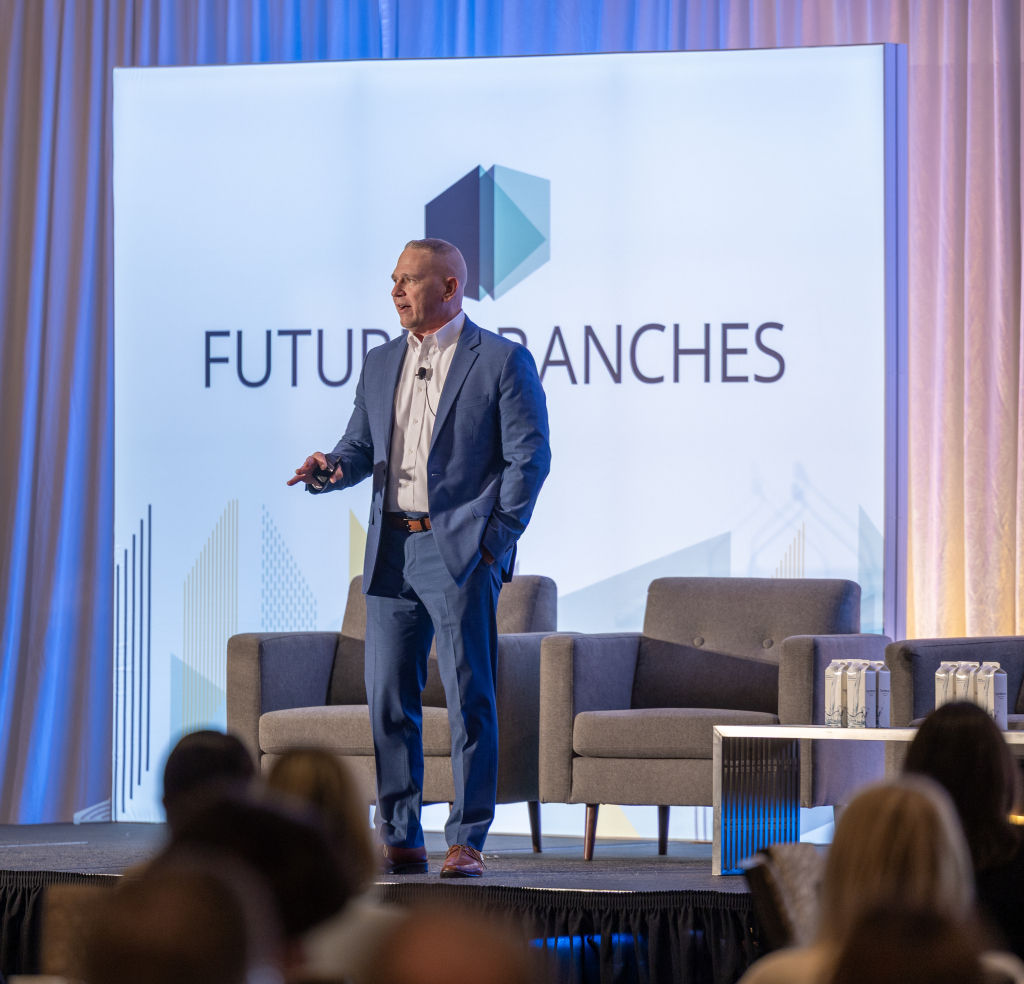
At Future Branches Boston 2025, Ray Ragan, Chief Information Officer at Security Plus Federal Credit Union, presented "AI Learnings So Far: What to Keep in Mind as You Begin to Implement It." Drawing from over a decade in banking AI and personal patents in fraud prevention and NPS capture, Ragan outlined ethical frameworks, AI definitions, and real-world impacts. This session equips financial leaders with pragmatic strategies to harness AI amid the fourth industrial revolution, enhancing efficiency without compromising human elements.
Key Takeaways
1. Ethical AI Principles
Ragan advocates four core ethical AI tenets: disclosure, consent, human accretive design, and human accountability. These principles ensure AI builds trust and prepares institutions for future scrutiny. As a proponent, he urges financial firms to embed them from rollout, positioning ethical adopters ahead in an impending "reckoning" on AI use, fostering sustainable innovation in banking.
2. AI Types and Evolution
Distinguishing artificial narrow intelligence (ANI)—predictive, generative, perceptive—from unachieved general (AGI) and theoretical superintelligence, Ragan notes ANI's long history, like early chess boards. Banking tasks are "prime real estate" for AI, especially as models improve relentlessly. This context helps leaders focus on current tools while anticipating broader capabilities.
Remember, the models that you're using today are the weakest, poorest models that will ever be in existence. In other words, it's only gonna get better or worse depending on how you look at it.
— Ray Ragan, Chief Information Officer, Security Plus Federal Credit Union
3. Empirical AI Impact in Call Centers
A study showed AI-human teaming shifts call resolution curves rightward, boosting resolutions per hour, tightening handle times to ~30 minutes from 42, and elevating Net Promoter Scores (NPS). Higher NPS predicts loyalty and profitability. Ragan, leveraging military insights, emphasizes human-machine teaming as the future, moving beyond vendor hype to proven gains.
4. Future Trends: Agentic AI and Runaway Scale
Normalization, agentic AI (autonomous actions), and "runaway scale" via large language models like ChatGPT will create competitive chasms, spurring M&A. Radical agility—AI-driven instant product pivots from social trends—demands speed. Amid a 10-year federal AI regulation moratorium, institutions must self-regulate ethically.
5. Practical Implementation Roadmap
Start with AI awareness surveys, threat assessments, third-party queries, and legal reviews to feed an AI risk assessment. Document controls for trusted data, deployment procedures, and incident management. Secure board-approved AI policy. Ragan warns: when regulators ask about AI use, demand their definition to avoid traps.
6. Human-Centric Scaling
AI scales technology, but people provide care. Ragan stresses balancing automation with human accountability, especially as the fourth industrial revolution disrupts all skill levels. Leadership means proactive changes to thrive, not fear the future.
Why It Matters
Ragan's insights resonate amid banking's AI race, where empirical data validates efficiency gains in customer service and NPS, directly tying to profitability. With uncertain U.S. regulation—contrasting Europe's caution and China's speed—financial institutions face "runaway scale" risks: early adopters gain agility, laggards merge or falter. Ethical, human-augmented AI addresses employee skepticism and regulatory traps, enabling pragmatic steps that enhance branches and contact centers in an omnichannel world.
Actionable Insights
- Adopt ethical AI principles: Disclose, ensure consent, make human-accretive, and retain accountability from day one.
- Conduct AI risk assessment: Survey threats, vendors, and regulations to build a board-approved policy.
- Test human-AI teaming: Pilot in call centers for faster resolutions and higher NPS.
- Prepare for agentic AI: Build trust in autonomous tools while demanding regulator definitions.
Want more insights from Future Branches Boston 2025? Explore the full agenda.
Click to View Full Session Transcript ▼
2025, Future Branches Boston. Presentation – AI Learnings So Far: What to Keep in Mind as You Begin to Implement It
[Conference Producer]: Next, we have a presentation, AI learning so far, what to keep in mind as you begin to implement it. Please join me in welcoming Ray Reagan to the stage.
Ray Ragan, Interim CEO, Security Plus Federal Credit Union: I don't know if our, there we go. All right. Hey, good afternoon and everybody. My name is Ray Reagan. I am the Chief Information Officer for Security plus Federal Credit Union. I've been working in the AI field and the banking field for over a decade now. I have implemented technology such as intelligent virtual assistants, chat bots those kinds of ais.
But the thing that really gives me a unique insight. Is that in addition to that, I am elbows deep in AI technology. On the weekends and the evenings, I'm actually coding AI and bringing AI technology to commercialization. The US Patent Office has awarded me with two patents. One is to capture real-time net promoter score in branch settings, and the other is to prevent check fraud.
I am also a big proponent of ethical ai, and I've boiled that down into four different things. One is that the AI is actually disclosed. Two, it's consensual. Three, it's human accretive, and then lastly, human accountable. And it's with these principles. That we've really been leading in ethical ai, which I would encourage any financial institution to con that is considering AI that you make those part, those principles, part of your rollout, because there is coming a reckoning on how we use ai, and if you've implemented ethical AI from the get go, you're gonna be in a good place.
Yeah, so I always like to start out with definitions and because AI has a lot of different definitions, I think it's important in order to have a constructive conversation to really understand what these definitions are. So let's start out with what is artificial narrow intelligent. This is also known as weakened ai.
And this is what most of us are currently using, and we've been using this for quite some time. I remember when I was young, I went to a garage sale and I bought a electronic chess board that you could actually play and it would play you. I thought that was the coolest thing ever. So right there, you could tell I was already on a trajectory for full blown nerdery, but that's okay.
But that is how long AI has been around. And depending on how you actually define it, it even predates that it goes all the way back into the fifties. So AI has been around with us a lot. But most of us right now are accustomed to using this weak AI or artificial narrow intelligence, and I like to, for the purpose of this talk, I like to really boil it down into these three subtypes.
One is predictive. That's your oss Two is generative. That's chat, GPT and any of the marketing and the chat engines that you use. And then three is perceptive. It's machines perceiving the world around it. Then we move on to what's called artificial general intelligence. And in the military, I've been working in with researchers and developers as a Army reserve officer.
And I can tell you that right now no one has achieved a GI. Yes, I know that there have been reports about it. I know that people have said that we think we achieved it, but nobody's actually been able to substantiate it. Now, the difference between a narrow AI and a general AI is think of general AI would be able to learn anything to do anything.
S it could do surgery, it could cook you a gourmet meal. These are the things that A GI could do. There is also the artificial super intelligence that is thankfully just a theory because once we achieve that mankind is going to be redefined. Speaking of being redefined, we are officially in the fourth industrial revolution.
Every industrial evolution up to this point has represented a substantial change in how we work. This industrial revolution is different. This is the first industrial revolution that is going to cut across the entire skills spectrum. It's not just going to impact folks working the looms as an as steam power started coming in on.
This isn't just going to affect, generally speaking, low skilled labor. This is going to cut across the entire skill spectrum. Things that we do as bankers is prime real estate for artificial intelligence. So I ask you in 2025 to stop and consider where you think AI is gonna go. And I caveat that with this.
Remember, the models that you're using today are the weakest, poorest models that will ever be in existence. In other words, it's only gonna get better or worse depending on how you look at it. So you may ask the question hey Ray, is AI actually making a difference? And, for ye for the last couple years that I've been talking about AI and banking conferences, I, it's been largely theoretical, right?
It's been, Hey, yeah. You can apply it to your cybersecurity, yes, you can apply it to your chat engines. Yes, you could apply it to your customer member experience when they call in, but we finally have actual data. There was an actual study done in an empirical journal that shows how a call center when.
Human and machines were teamed together and the impacts that it had. So let me orientate you to this diagram. So green is those that have never used ai. Red is those that are starting to use ai. And the purple or blue is those that have been using ai. And what you're seeing is this call center, and you can see there's a dramatic shift.
On the peak of the curve to the right, meaning the call center agents were able to resolve more calls with the assistance of ai. And again, drawing on my military experience, there's a really this big concept around human machine teaming. I don't think we're gonna see that go away. In fact, I think that is the future, at least the foreseeable future.
Resolutions per hour. Every one of these shifts to the right, represents a call center that's running more efficiently. What does that look like for handle time? And here again, here you have the never AI green pre AI just getting used to it, and then purple ai and look at how that curve tightened really up.
And so in this call center. Now they are on average handling most of these calls in about 30 minutes as opposed to, looks like about 42. Okay. Something that's near and dear to my heart Net Promoter score. What did this do for Net Promoter Score? Firstly, if we take a peek at this and we can see that we had this kind of bulge in green over here between 40 and 60, and so these were customers.
Getting calling in and getting frustrated and expressing that with poorer NPS, but those agents, as they continue to use ai, the net promoter score started going up. And we all know what Net promoter score is a predictor of loyalty, which is a predictor of profitability. Yes, AI is making a difference.
We finally actually have some empirical studies done that actually shows it. It's not just listening to vendors talk about their solutions. 'cause Lord knows every vendor's got an AI solution. So what does this actually look like in the long term? Here we have a diagram of technology and market intersecting.
On the left hand side is those things that are more certain and on the right hand side are the things that are less certain. So I, I don't have the time to talk unfortunately about all of these things, so I'll just talk about a couple things. One is that normalization of ai, we're gonna get to the point where ai, that term's gonna start to decline is just gonna become.
Part of how we do business. I know it's mind blowing and I know that e j's already talked about the drinking game and I'm sure by then we'll have something else. The other thing that gets me really excited about in, in that left hand side more certain area is this concept of agenda ai.
That's AI that has agency AI that can do things. Right now we're establishing trust with our AI models. But as that a, as that trust starts coming up, we're going to start trusting AI to do more and more. And that's where those four principles of AI ethics start becoming very important. And please let me implore you don't ever take out that human accountability.
That's why we're in business. There is one change in this slide that since the last time I presented it, that term regulation right in the middle. If you would've asked me in December of 2024 if we were gonna get regulation on ai, I thought for sure we were going to get it, but now I'm not so sure.
Did you know that in the big beautiful bill. It actually has a 10 year moratorium on any AI regulation, and the federal government is exercising preemption, which means states can't pass their own AI regulation. This is something that I just didn't call it. It really did come out of nowhere. So here we're sitting in this in-between space of regulation and not really knowing where it's gonna happen.
There's one other in that middle column that I want to talk about, and this is sitting between more and less certain, and that's runaway scale. And the reason why runaway scale is so important is those that figure out how to employ ai. And for the purposes of this talk, I'm really talking about large language models.
That's chat, GPT, cloud Gemini, those types of ais. Those that figure that out are going to start having runaway scale. And what that means is anyone that hasn't adopted that is gonna have a harder and harder time to compete. And of course we're gonna see additional mergers and acquisitions come out of this if we get over into the final right hand column, less certain.
There's one principle I wanna call out and that's radical agility. People often ask, they're like, Ray, what? What is radical agility? Imagine coming in Monday morning and your AI said, Hey, I analyze all the Instagram and TikTok trends over the weekend, and I'm recommending these three products. You say, okay, go on Product A.
We'll just say Product A. It's gonna go and make all the changes in your core. All the changes in your website, all the changes in your marketing, and all the changes in your care, almost instantaneously. That's what I mean by radical agility. And here's the crazy thing, that's Monday when you come in Wednesday, it's gonna have three new recommendations.
That's how fast we're gonna start moving. So let's talk a little bit more about practicality. I. So if your auditor asks if you are using ai yes, admirable Act bar, it is a trap. Ask your regulator to define what she or he means by ai. Ask them because if they, if you define it for them, it is a trap. So make sure that when your regulator or examiner asks if you're using ai.
Ask them to define it for you and ask them to define how we're, how they mean that you're using it. So if you're using it for lending decisions, business decisions, those are all caveats that you need to know. Okay. So I'm ready to get started in using AI in my financial institution. So here's the roadmap.
This is the first thing you need to do, is you need to survey and get a general awareness of ai. You need to find out about how AI might be used to attack your financial institution and to implement those appropriate defenses. Then you need to actually do a query of all your third parties and find out how or if they're using AI and evaluate those risks.
You need to document the objectives, responsibilities, et cetera, as part of this general survey. And then lastly, you need to understand the legal and regulatory requirements involving ai. You're gonna take all four of these inputs and put them into your IT risk as, or AI risk assessment. So the other thing that you're gonna need to do is you're going to need to show how you're controlling it, and you need to show that generative AI is being used to make informed decisions.
That the data going into the AI is trusted and protected, that you have procedures to deploy generative ai and also that you actually do have the incident management to handle if there's an AI incident. This is the roadmap to get you to this, an AI risk assessment and a board AI policy that's been approved.
It's not just enough to bring it in and have them so noted it needs to be approved. So why are we doing this? AI is about scaling with technology, but caring with people. AI can't care the way that you care, so please scale with the technology. But care with your people. So the question I often ask is this fourth industrial revolution is here.
How are you going to lead? What changes are you gonna make in your financial institution to be ready? Because the future that lays ahead can be a scary one if you don't get in front of it. I am Ray Reagan, and this is the roadmap on how to bring AI into your financial institution. I've got time for looks like maybe one or two questions.
What questions do you have for me?
Yes, sir. What's your view on whether that of regulation thing probably a little bit of both. So the question is what's what is my view of whether or not regulation is a good or bad thing? And candidly if we see how Europe is handling it, they are handling it very regulated.
They're going very slow. And then we have China who has almost no regulation. And so the question is who's going to, who's gonna end up ahead? I think we know where that horse is or what horse is gonna come out in that, that race. It so it, it does have good and bad. It's just like crypto, right?
It's not regulated and there's all sorts of innovation, but then, if people get their entire life savings wiped out, because it got hacked. I hate to give you such a ambivalent answer, but I think that's probably the most candid one. I got time for one more question. Please.
So my question is, I'm trying to figure this out.
[Conference Producer]: Do you see AI being monetized from a sales perspective, almost like has done, I
guess I've. Yeah. So the question is do we see AI as being monetized like Google has? I think the answer's almost absolutely. It's coming. One thing I think you'll see probably in the next five years in the, in our vendor area, we'll start to see people actually selling proprietary large language models that, that actually give you protected data.
I. I, I'd hate to step away from chat GPT just 'cause it's such a powerful tool, but at some point, our need to be able to say, Hey, I need to know for sure that these recommendations are not solely by some sort of commercial consideration is gonna probably come into the play.
We thought regulation was gonna do it, but maybe the business needs will be what actually does it. And thank you everybody. I recognize I'm at time. I appreciate the opportunity to share with you everything that I've learned about AI over the last, gosh, five years. Thank you.
[Conference Producer]: Thank you so much, Ray. We're just going to get this podium removed really quickly, and then I will bring our next panelist step.